Celebrity brands rely on celebrity. Your beauty store cannot. So if you want to build a celebrity-level beauty store without the celebrity, your Shopify storefront has to do more than just sell products. It has to create desire, build trust, make the product feel premium, and convince a stranger that your beauty brand is worth buying from.
That sounds obvious, but most beauty founders forget what it really means.
It is not hard to build a “brand world” when the founder is already famous. It is not hard to make a product drop feel important when millions of people already know the name. It is not hard to get attention when the launch is backed by fame, money, press, influencers, photographers, creative directors, paid media, and a built-in audience waiting to see what happens next.
Celebrity beauty brands are not playing the same game as you.
Their store can be average in places and still sell because the celebrity is doing part of the selling. The name creates trust. The lifestyle creates desire. The audience creates traffic. The press creates proof. The founder’s face creates familiarity.
You do not have that shortcut.
So your store has to work harder.
Your Shopify store has to create the desire the celebrity name would normally create. It has to build the trust the public image would normally build. It has to make the product feel expensive before the shopper ever tries it. It has to guide the customer through shade, routine, texture, value, proof, cart, and checkout without losing them.
That is the real game.
– Not “make your site pretty.”
– Not “use better fonts.”
– Not “add a luxury color palette.”
The goal is to build a store that makes a stranger believe.
Because when you do not have celebrity, belief has to come from the storefront.
To go deeper into this system, download the free ICON Beauty Store Blueprint. It breaks down the design psychology, product-page structure, trust architecture, shade presentation, bundles, and mobile checkout flow behind premium beauty stores.
The celebrity brands advantage nobody wants to admit
Most articles about celebrity beauty brands miss the obvious.
They talk about packaging. They talk about social media. They talk about “community.” They talk about brand storytelling.
But the real advantage is simpler.
Celebrity brands start with borrowed trust.
People already know the face. They already have an opinion. They already understand the aesthetic. They already associate the founder with beauty, status, body, skin, makeup, confidence, glamour, or aspiration.
That means the store does not have to introduce the entire brand from zero.
A regular beauty founder has a harder job.
When a stranger lands on your Shopify store, they are silently asking:
- Who are you?
- Why should I trust this?
- Why does this cost this much?
- Will this work for me?
- Is this brand serious?
- Is this product actually good?
- Can I choose the right shade?
- Will I regret buying this?
Celebrity brands get to skip some of those questions.
You do not.
So your store has to answer them fast.
12 strategies to build a celebrity-level beauty store
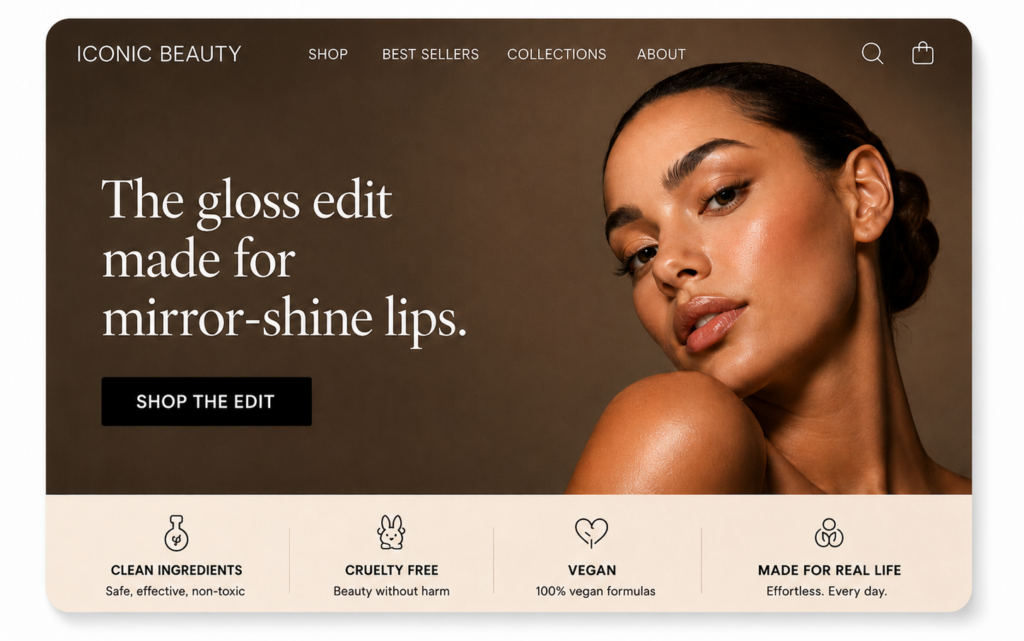
1. Stop arriving like a small brand
Most small beauty stores reveal themselves immediately.
The homepage opens with a weak hero image, a vague headline, a discount pop-up, a “shop now” button, and a product grid that looks like every other Shopify store.
That tells the customer one thing:
This is small.
Small is not the problem. Looking unconsidered is the problem.
A celebrity-level store opens with control. It does not panic. It does not throw every message onto the first screen. It does not beg for attention with three announcements, a spinning discount wheel, and a cluttered banner.
The first screen should feel like a campaign.
One product moment.
One visual direction.
One strong sentence.
One clear action.
| Bad | Better |
| “Welcome to our beauty store. Shop our products.” | “The gloss edit made for mirror-shine lips.” |
| “Natural skincare for everyone.” | “Your evening skin reset, built around barrier care.” |
| “New collection available now.” | “The soft-matte lip wardrobe for every day, night, and camera flash.” |
The difference is not poetry. The difference is positioning.
A weak hero says what you sell.
A strong hero makes the product feel like a world.
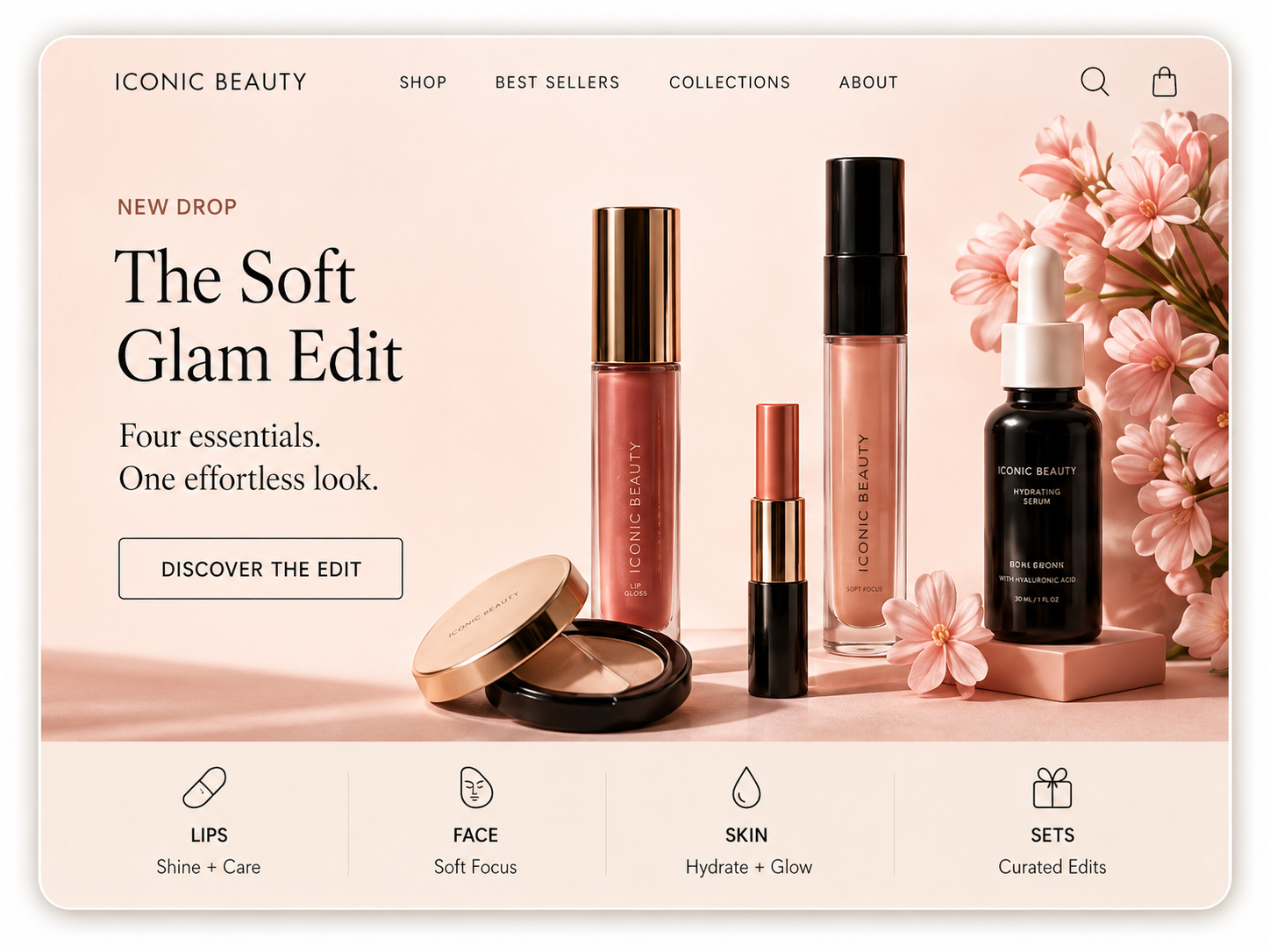
2. Build a moment, not a product
Celebrity brands understand product moments.
A launch feels like an event. A collection feels like an edit. A bundle feels like a look. A restock feels like demand.
Most Shopify beauty stores do the opposite.
They dump products onto the homepage and hope the customer figures it out.
That is not premium. That is inventory.
A celebrity-level store gives shoppers a reason to care about something specific right now.
You can create a product moment around:
- a new shade
- a bestselling gloss
- a three-step skincare routine
- a limited bundle
- a summer body care edit
- a “soft glam” look
- a restocked hero product
- a founder’s favorite set
You do not need celebrity fame to make a product feel important. You need framing.
| Instead of | Say |
| “Shop lip gloss.” | “The High-Shine Lip Edit.” |
| “Skincare bundle.” | “The 3-Step Glow Routine.” |
| “Body lotion and oil set.” | “The After-Shower Body Ritual.” |
Names create perception. Structure creates value. Context creates desire.
If you treat your products like random SKUs, customers will treat them like random SKUs.
3. Feel expensive before they see the price
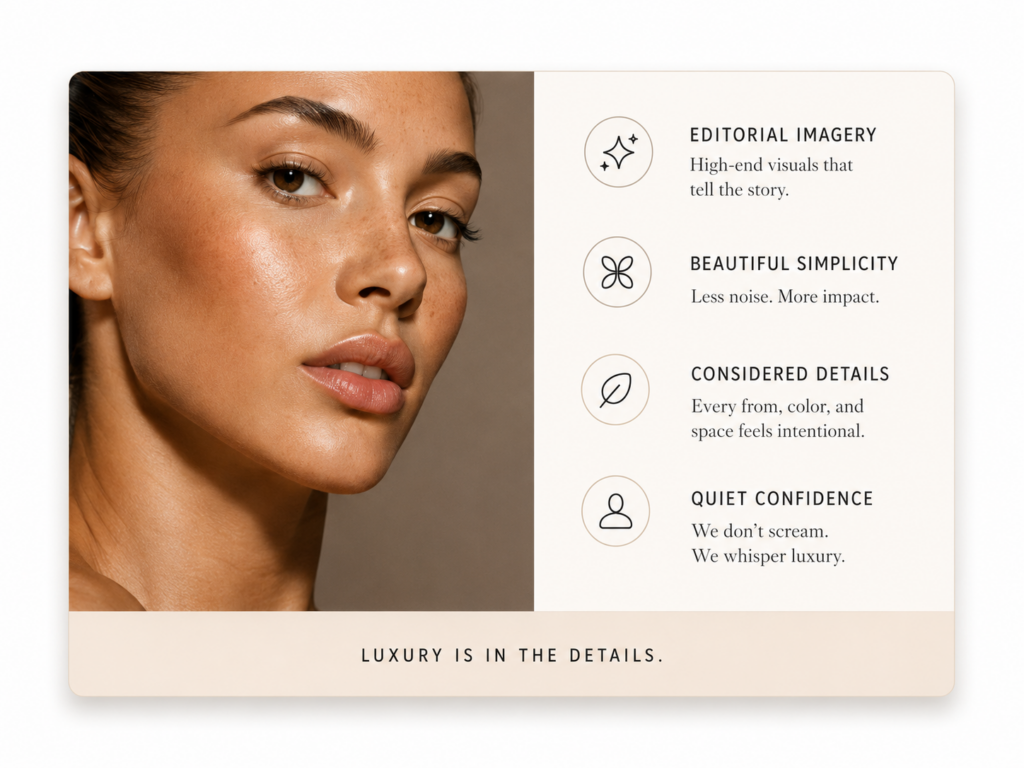
Beauty shoppers judge fast.
They judge the photography.
They judge the spacing.
They judge the logo.
They judge the product names.
They judge the product page.
They judge the cart.
They judge whether your store feels like a real brand or a Canva project with checkout enabled.
This sounds harsh, but it is true.
Your product can be good and still feel cheap online.
That is the danger.
A celebrity-level store makes the product feel expensive before the customer thinks about price. It does this through restraint, consistency, and confidence.
Not every section needs a paragraph.
Not every product needs a badge.
Not every page needs a discount.
Not every claim needs to be shouted.
Premium design often feels quieter because it does not look desperate.
Cheap-looking stores over-explain.
Premium stores frame.
Cheap-looking stores chase the sale.
Premium stores create desire first.
Cheap-looking stores use random sections.
Premium stores create a journey.
Before you add another app, another pop-up, or another banner, ask the harder question:
Does this make the product feel more valuable, or does it make the store feel more desperate?
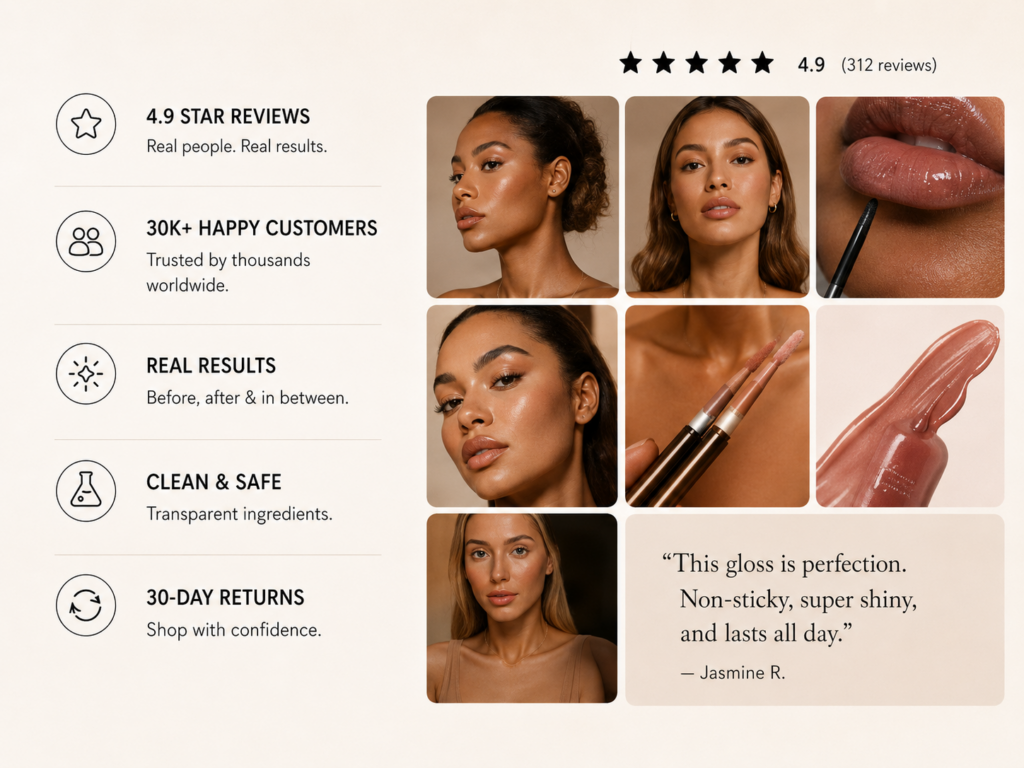
4. Replace celebrity trust with store trust
Celebrity brands borrow trust from the person behind the brand.
You do not have that.
So your store needs its own trust architecture.
Trust architecture means proof appears exactly where doubt appears.
Not hidden at the bottom.
Not buried in a reviews tab.
Not scattered randomly.
Not treated like decoration.
Beauty customers doubt different things at different moments.
Near the product title, they wonder:
Is this popular? Do people like it?
Near the shade selector, they wonder:
Which one is right for me?
Near the formula claim, they wonder:
Is this actually true?
Near the add-to-cart button, they wonder:
Is this safe to buy? What if I do not like it?
Near the cart, they wonder:
Should I really check out now?
So trust has to move through the page.
Use ratings near the title.
Use shade-specific reviews near shade choice.
Use ingredient clarity near formula claims.
Use UGC near product imagery.
Use shipping and return reassurance near add-to-cart.
Use routine recommendations in the cart.
This is how an unknown brand starts to feel credible.
Not by saying “premium.”
By removing doubt.
5. Stop making a buy feel like a gamble
If you sell makeup and your shade selector is just tiny color circles, you are losing people.
A customer does not want to guess.
They want to know:
- Is this warm or cool?
- Is this sheer or pigmented?
- Will this look good on my skin tone?
- Is this brown, pink, peach, mauve, red, nude, or clear?
- Does the product image change when I pick a shade?
- Can I see it on a person?
- Can I compare the shades?
Celebrity brands often get shade trust from the face of the founder or from massive social exposure. Customers see the product on influencers, creators, campaigns, and fans.
You may not have that level of exposure yet.
So your Shopify shade selector has to carry more weight.
A better shade selector includes:
shade names
undertone descriptions
finish labels
model references
swatch photos
variant-specific images
shade family grouping
clear “best for” notes
Instead of:
“Shade 04”
Use:
“Shade 04 — warm rose nude, satin shine.”
Instead of:
“Brown”
Use:
“Cocoa Glaze — sheer chocolate brown with warm undertones.”
This is not extra copy for the sake of copy. It is conversion support.
A confused customer does not buy.
A confident customer adds to cart.
6. Make the product page sell like a commercial
Most beauty product pages are too lazy.
They show an image, a title, a price, a short description, and a button. Then the founder wonders why ads are not converting.
The product page is not just a product page.
It is the sales page.
It has to do the job your celebrity founder would have done in an interview, a GRWM video, a launch post, a tutorial, a press feature, and a friend recommendation.
A strong beauty product page should answer:
- What is it?
- Why should I want it?
- What result does it create?
- Who is it for?
- How do I choose the right variant?
- What does the texture, finish, or formula feel like?
- How do I use it?
- What do real customers say?
- What should I pair it with?
- Why should I trust this brand?
- What happens after I order?
If your page does not answer those questions, the customer has to fill in the gaps.
And when customers have to guess, they hesitate.
A celebrity-level product page does not just describe the product. It removes friction from the decision.
7. Turn products into rituals, edits, and looks
Celebrity brands are good at making products feel like part of a lifestyle.
That is the part founders should study.
Not the celebrity.
Not the hype.
Not the drama.
The framing.
A cleanser is not just a cleanser. It is the first step in a skin reset.
A gloss is not just a gloss. It is the finishing touch before you leave the house.
A blush is not just a blush. It is the soft-focus color that makes the whole face look alive.
A body oil is not just a body oil. It is the after-shower ritual that makes skin look expensive.
This is how you create perceived value.
On Shopify, create sections like:
- Complete the Look
- Build the Routine
- The 3-Step Ritual
- Pair It With
- Your Night Skin Edit
- The Soft Glam Set
- The Glow Body Routine
This helps customers buy more without feeling like they are being upsold.
- Random upsells feel cheap.
- Curated routines feel premium.
That distinction matters.
8. Make offers feel like taste, not tactics
Bundles are not automatically premium.
Most bundles look like a discount strategy wearing a nice name.
A celebrity-level beauty store makes bundles feel curated. The customer should feel like the brand has taste. Like the set was chosen for a reason. Like the products belong together.
| Bad bundle | Better bundle |
| “Lip Bundle — Save 15%” | The Soft Nude Lip Edit |
| “Skincare Set” | “The Morning Glow Routine” |
| “Body Care Duo” | “The Post-Shower Skin Ritual” |
Discount can exist, but it should not be the whole story.
The story should be the result.
Beauty customers do not just want more products. They want the right combination. They want confidence. They want the completed look, the finished routine, the easier decision.
Bundles work when they reduce thinking.
They fail when they feel like you are trying to squeeze more money out of the cart.
9. Design mobile like that is the only store that exists
Your desktop store is probably not the real store.
Your mobile store is.
That is where customers land from TikTok, Instagram, email, influencer content, ads, texts, and screenshots from friends.
And mobile exposes everything.
Bad spacing feels worse.
Bad swatches feel smaller.
Long descriptions feel heavier.
Hidden reviews feel more hidden.
Slow pages feel slower.
A missing sticky add-to-cart feels more annoying.
A messy cart feels more suspicious.
A celebrity-level mobile store has to feel clean, quick, and obvious.
The customer should always know:
- « What am I looking at? »
- « Which shade did I choose? »
- « What does this product do? »
- « Can I trust it? »
- « How do I add it to cart? »
- « How do I check out? »
This is why sticky add-to-cart matters for beauty stores. Product pages are long because beauty products need explanation. The buying action should not disappear just because the customer scrolled.
Mobile is where a premium brand can suddenly feel cheap.
Do not let the mobile version expose the weakness of the store.
10. Make the cart page feel like a beauty counter
The cart drawer should not feel like a warehouse receipt.
It should feel like the final step at a beauty counter.
The customer has chosen something. Confirm the choice. Show the shade. Show the product image. Make the checkout button obvious. Recommend something that actually makes sense. Reassure them about shipping or returns.
A strong beauty cart drawer can include:
- selected shade
- product thumbnail
- free shipping progress
- routine-based recommendation
- matching product suggestion
- trust message
- clear checkout button
- easy remove/edit option
The cart drawer is also where many brands ruin the premium feeling.
Too many upsells.
Too many apps.
Too much noise.
Too much pressure.
Too many progress bars, badges, timers, and random add-ons.
That makes the store feel desperate.
A good cart drawer should feel helpful and controlled.
-> If the customer adds a lip liner, suggest the matching gloss.
-> If the customer adds a serum, suggest the moisturizer in the same routine.
-> If the customer adds a body oil, suggest the body wash from the same scent family.
That feels like service.
Service feels premium.
11. Stop using discounts as your brand strategy
A lot of beauty stores train customers not to respect the brand.
The first thing visitors see is a discount.
Then another discount.
Then a bundle discount.
Then a free shipping bar.
Then a timer.
Then a pop-up.
Then a spin wheel.
Then a “last chance” message…
That might get short-term sales, but it can destroy the premium feeling.
Celebrity brands often do not need to lead with discounts because the attention already exists. Independent brands often panic and use discounts to create urgency.
But urgency is not the same as desire.
If your store relies too much on discounts, customers start to believe the product is not worth full price.
A better premium strategy is to lead with:
- product value
- routine value
- shade confidence
- formula clarity
- visual desire
- customer proof
- bundle curation
- limited edits
- founder point of view
Use discounts carefully. Do not let them become the loudest part of the brand.
A celebrity-level store does not beg.
It makes the product feel wanted.
12. Replace fame with a system
This is the whole point.
You are not famous.
Your store has to be disciplined.
You may not have celebrity traffic.
Your store has to convert the traffic you have.
You may not have instant trust.
Your store has to build it.
You may not have massive cultural relevance.
Your store has to create a world that feels specific enough to care about.
You may not have a famous face.
Your store has to make the product the star.
That is how you build celebrity-level without celebrity.
Not by waiting for your brand to be famous one day.
By replacing their built-in advantages with ecommerce structure.
The ICON framework breaks this into five jobs:
| Desire | Make the product feel valuable before the shopper compares price. |
| Clarity | Make the offer easy to understand. |
| Confidence | Help the customer choose the right shade, routine, bundle, or product. |
| Trust | Place proof where doubt appears. |
| Action | Make add-to-cart and checkout obvious, fast, and mobile-first. |
That is the system.
A pretty store is not enough.
A premium store makes the customer believe.
A conversion-ready store turns that belief into action.
Download the free ICON Beauty Store Blueprint to audit your storefront and learn the beauty ecommerce system behind product pages, shade selectors, bundles, trust signals, and mobile checkout.
The real thing: Would this store still sell without fame?
This is the question every beauty founder should ask.
If a celebrity name was removed from the logo, would the store still feel strong?
- Would the product still feel desirable?
- Would the page still explain the value?
- Would the shopper still trust the formula?
- Would the shade selector still help?
- Would the bundle still make sense?
- Would the cart still feel premium?
- Would the mobile experience still feel effortless?
That is the standard.
Celebrity brands can lean on fame. You cannot.
So build the store that makes a stranger understand the product, want the product, trust the product, and buy the product without needing to know who you are first.
That is a celebrity-level store without the celebrity.
-
How do you build a celebrity-level beauty store without being famous?
You build a celebrity-level beauty store by replacing fame with structure. Your store needs to create desire, explain the product clearly, guide shade or routine selection, place trust signals where doubt appears, use curated bundles, and make the mobile checkout path effortless -
Why do celebrity beauty brands sell so easily?
Celebrity beauty brands often start with built-in attention, trust, press, and audience demand. The celebrity gives the brand instant recognition. Independent beauty brands do not have that advantage, so the storefront has to create more trust and desire on its own.
-
What makes a beauty store feel premium?
A beauty store feels premium when the visuals, product page, copy, shade selector, reviews, bundles, cart drawer, and mobile flow all feel intentional. Premium design is not just about looking beautiful. It is about making the product feel valuable and easy to trust
-
Should I copy celebrity beauty brand websites?
No. You should not copy their branding, imagery, colors, names, campaigns, or layouts. Instead, study the psychology behind them: product framing, visual consistency, trust placement, guided shopping, curated edits, and mobile-first conversion.
-
What is the biggest mistake beauty brands make on Shopify?
The biggest mistake is treating the store like a product catalog instead of a sales environment. Beauty customers need desire, shade confidence, product education, social proof, routine guidance, and a smooth checkout experience.
Laisser un commentaire